PUBLICATION
Winthereik, B. & Munk, A. K., (2023). Digitalizing everyday life in Denmark during the Corona crisis: The construction of an ethnographic archive. In: Abram, S., Lambert, H. & Robinson, J. eds. How to Live Through a Pandemic, ASA Monographs, London: Routledge.
Manuscript available as full text.
BibTex
@incollection{winthereik2023digitalizing,
title={Digitalizing everyday life in Denmark during the coron
crisis: The construction of an ethnographic archive},
author={Winthereik, Brit Ross and Munk, Anders Kristian},
booktitle={How to Live through a Pandemic},
pages={92--113},
year={2023},
publisher={Routledge
}
When COVID-19 hit Denmark in March 2020, I got a call from Brit Ross Winthereik. We found ourselves in an unusual position as researchers whose subject matter — the digitalization of everyday life - was suddenly happening in real time, at scale, all around us. We had to move fast.
Together with a team of 18 research assistants from the IT University of Copenhagen and Aalborg University, we launched the ‘Grammar of Participation’ project to document how people in Denmark were improvising new digital routines under lockdown. Virtual yoga classes, online Easter lunches, a soccer match streamed to fans on Zoom - people were tinkering with their social lives in ways that felt both urgent and fleeting. We wanted to capture that before it was washed away.
In this book chapter, describe our collective construction of an ethnographic archive: 235 interviews, 90 participant observations at virtual events, 83 smartphone diaries, and 138 digital leads generated through social media analysis. One of the things I’m most proud of is the four-protocol structure we developed on the fly, where a digital methods team actively scouted social media for leads and fed them to the interview, observation, and mobile ethnography teams.
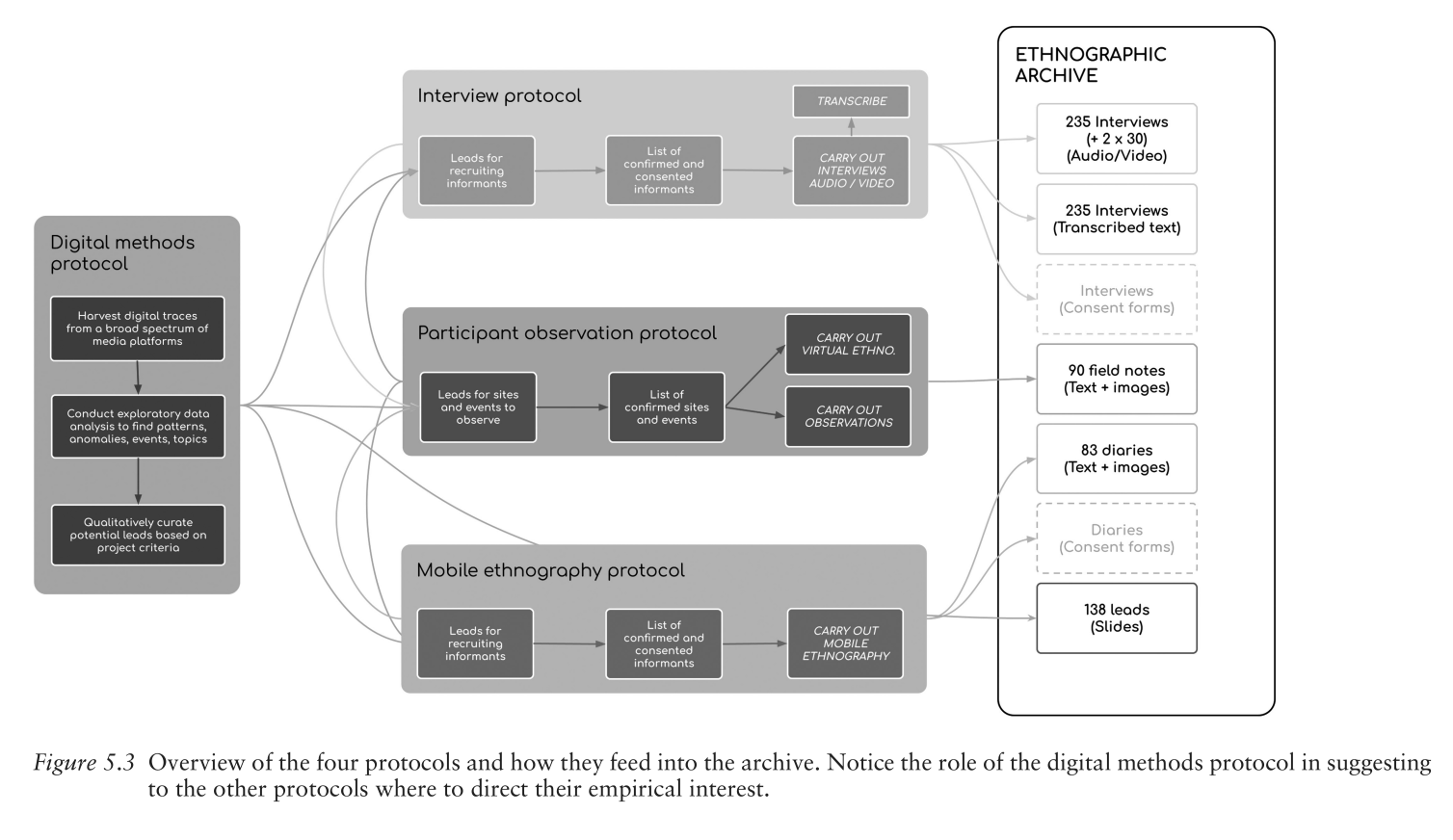 But the chapter is also candid about what was hard. Using the archive turned out to be far more complicated than we anticipated. A PhD student working with our materials later told us she could only find one interview she really felt she could use - one where the interviewer had dropped the script and simply shared the experience of lockdown with the participant. That observation stuck with me. Rapport, it turns out, doesn’t archive easily.
The chapter is published in How to Live Through a Pandemic? and is part of a broader reflection on what pandemic fieldwork taught us about digital environments as research spaces: not a plan B for real ethnography, but a research environment with its own intimacies and challenges.
p.97
The first lockdown in Denmark was announced with a duration of two weeks, which was eventually extended to several months, but this was a developing situation and, in any case, there was good reason to believe that the experience of a disrupted everyday life would change considerably as time went on, hence underlining the need to begin fieldwork (not least generating leads for informants, negotiating access, and establishing some form of however provisional rapport) immediately. Taken together, these arguments weighed in favour of a team of ethnographers working in concert, thinking on our feet to collectively develop the research design as we tuned in with informants, and made use of whatever digital help we could get in terms of scouting where the field was and how we could actually construct it
pp.109-110
What can we learn about ethnographic rapport when studies of everyday life depend on secondary data generated through digitally mediated situations by means of collaborative methods? (…) they tell us that we can be qualitative at scale only if we allow ourselves to include our reflections, assessments, and judgements in the analysis. To analyze people’s experiences, we need to explore their assumptions about how the world works. How to get at the relations between what they consider disturbances and their modes of ordering otherwise? Experienced ethnographers will begin regular fieldwork with an understanding that they do not know what they don’t know. They will ask questions, listen, and observe. To use an archive like ours with secondary materials and a lack of overview of the data, such a sense of achieved ignorance is crucial.